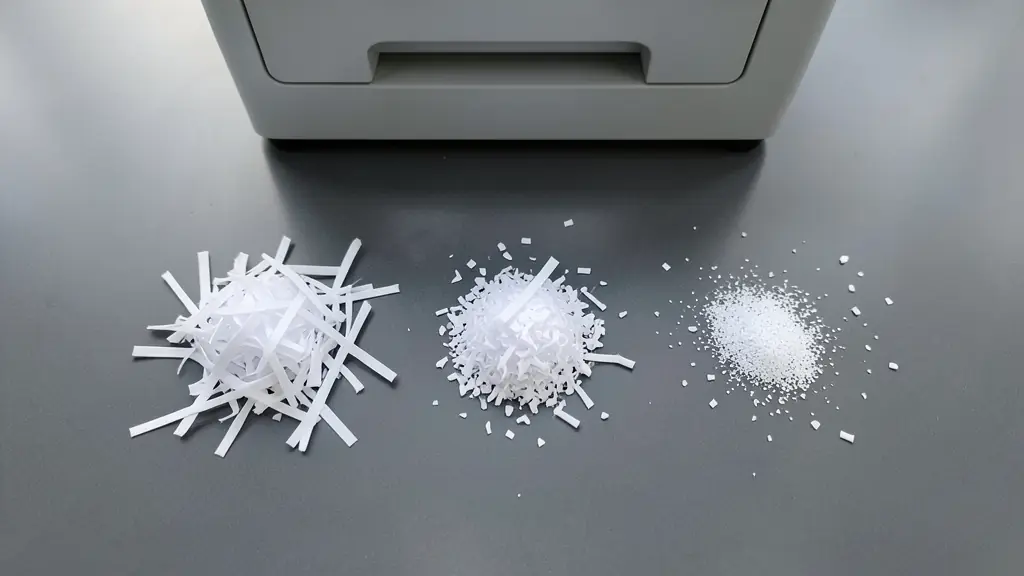
The P number on a shredder tells you how small it cuts paper and how hard the pieces are to put back together. Here is what each level means, which documents need which, and a quick check of the level from your shredder's cut size.
The P-1 to P-7 levels
DIN 66399, also published as ISO/IEC 21964, sets seven security levels for shredding paper, from P-1 (easy to piece together) to P-7 (practically impossible). The level depends on the largest particle the machine leaves. Pieces from an A4 sheet are worked out from the largest particle allowed.
| Level | Largest particle | Cut | Pieces from A4 | For | Examples |
|---|---|---|---|---|---|
| P-1 | 2,000 mm² | 12 mm strips | at least 31 | General documents to be made unreadable | Old drafts, adverts, internal memos with nothing personal |
| P-2 | 800 mm² | 6 mm strips | at least 78 | Internal documents | Internal lists, notes and forms with little personal information |
| P-3 | 320 mm² | 2 mm strips | at least 195 | Sensitive and confidential documents, personal information | Customer letters, quotes, CVs, delivery notes with addresses |
| P-4 | 160 mm² | particles up to 6 mm wide | at least 390 | Highly sensitive documents, personal information that needs more protection | Payroll, staff files, bank statements, invoices, client files, ID copies |
| P-5 | 30 mm² | particles up to 2 mm wide | at least 2,079 | Confidential documents with a high need for protection | Medical and legal files, contracts, tenders, account and card details |
| P-6 | 10 mm² | particles up to 1 mm wide | at least 6,237 | Secret documents with very high security precautions | Research, patents, security plans, documents under special secrecy |
| P-7 | 5 mm² | particles up to 1 mm wide | at least 12,474 | Top secret documents, the highest security | Government and defence material classified as top secret |
Common office shredders: a 6 mm strip-cut is P-2, a 4 × 40 mm cross-cut (160 mm²) is P-4, and a 2 × 15 mm micro-cut (30 mm²) is P-5.
What POPIA means for shredding
The Protection of Personal Information Act asks businesses to keep personal information secure (section 19) and, when records are no longer needed, to destroy them in a way that prevents them from being reconstructed in an intelligible form (section 14). It does not name a shredder level. For most offices, P-4 cross-cut is a sensible minimum for anything with names, ID numbers, addresses or account details, and P-5 for medical, legal and financial files.
For large volumes or archive clear-outs, an on-site or off-site shredding service with a certificate of destruction is often cheaper and easier to prove. See paper shredders and shredding services, and when a copier leaves, ask for its hard drive to be wiped (photocopier recycling).
Frequently asked questions
What shredder security level do I need for POPIA?
Is cross-cut or micro-cut better?
What does P-4 mean on a shredder?
More copier tools
Calculators & tools
Size a copier, cost a page, compare lease and buy, and look up paper sizes
- Copier size calculatorThe speed class, A4 or A3 and the monthly volume a copier should be built for
- Cost per page calculatorWhat each page really costs in toner or ink, drum and paper, and against a click charge
- Lease vs buy calculatorBuying, leasing or renting a copier, with the click charges, over the same term
- Toner yield calculatorHow many pages a cartridge gives at your coverage, how long it lasts and when to reorder
- Copy paper calculatorReams, boxes, weight and cost of paper a month or a year, with double-sided savings
- Binding size calculatorThe comb or wire size for a document from its sheets and paper weight
- Paper sizes and weightsA, B, C and SRA sizes in mm, reduce and enlarge percentages, and gsm weights
- Photocopier dimensionsTypical sizes and weights of desktop, A3 and production copiers, and the space to leave
- Copier glossaryPPM, duty cycle, click charge, MFP, DADF, drum, fuser and other copier terms explained